
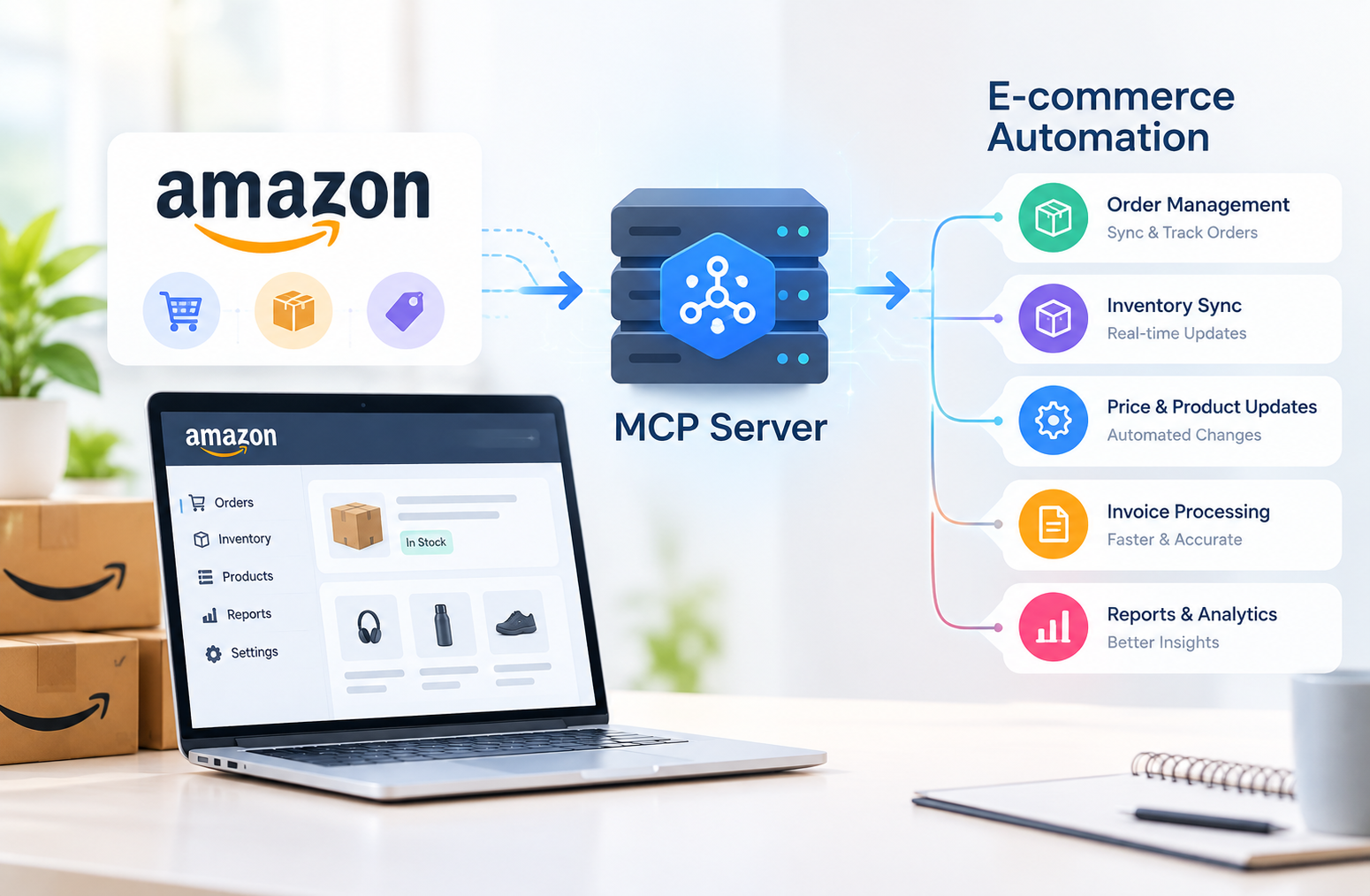
As businesses expand and grow on Amazon, the number of orders, inventory, product information, pricing, returns, and reports becomes more complex. A small list of products can become cumbersome when the volume of orders and the amount of operational data grows.
The majority of Amazon sellers continue to use manual checks on their dashboard, spreadsheets, repetitive reporting, and unconnected business systems. Such processes can eat into team time and make it more difficult to react rapidly to operational changes.
Amazon to MCP Server Integration lets you integrate Amazon-related data and tools into your AI applications using the Model Context Protocol (MCP). Rather than having AI and Amazon operations running as distinct entities, businesses can set up controlled workflows that integrate AI applications with approved tools and data.
This can be used to help automate eCommerce on Amazon, which can help businesses to decrease redundant operational duties and provide a more accessible method for teams to interact with marketplace data.
What Is MCP Server Integration?
Model Context Protocol (MCP) is a framework for standardized interactions between AI applications and external tools, services, and data.
Simply put, an MCP server can be used to provide a controlled connection between an AI application and business systems. Instead of the AI application having access to an entire system, businesses can specify the tools and resources the AI can use.
Traditional Amazon API Integration makes it easy to communicate directly with Amazon services from software applications using specific API endpoints. The top layer of the connected tools and data is added by MCP, which is AI-oriented.
For instance, Amazon MCP Integration could offer an approved tool to fetch inventory data. The application could then be fed by an AI when users ask what products are close to their stock level.
Amazon Operations That Can Be Transformed With MCP
Streamlining Amazon Order Management
Order management can involve checking order details and finding orders that need attention. An MCP-based workflow can get approved order data. Arrange the right information for AI tools.
Companies can use this method to track order status, find orders that might be delayed, and help with follow-up steps. Human review can still be part of the process when a decision needs thought or approval.
Improving Inventory Management
Inventory data is another place where automation can cut down on repeat work. An MCP server can share approved inventory tools with an AI application.
The system can get inventory data, find products that meet low-stock rules, and start alerts or restocking steps. Inventory data can also be linked with ERP or inventory systems.
Managing Product and Catalog Information
Big product lists can have missing or incorrect information. AI-powered steps can help groups check product details faster. An MCP server can give access to approved product data, letting AI tools find parts, sort information, or suggest things to check.
Instead of letting AI change the catalog freely, companies can make steps where any changes are checked and approved before they are used.
Monitoring Pricing and Product Information
Companies might need to check product and price details based on rules. Amazon MCP Integration can help with steps that get the data and find set conditions.
For example, an AI tool could help point out products that fit a price or monitoring rule. Alerts or suggestions can then go to the team.
Steps that can directly change prices or marketplace actions should have the controls and human approval when needed.
Supporting Returns and Customer Service
Returns and customer questions often need info from places. An AI-powered step can bring together approved return and order details to help customer service teams see problems faster.
AI can also explain customer or order issues and link those findings with support steps, helping teams focus on cases that need human help.
Automating Reporting and Business Analytics
Reporting is another use for MCP automation. Instead of taking time to collect data from many systems, companies can build steps that get approved Amazon data and make organized summaries.
Teams can use AI to ask questions about Amazon business data, create operational summaries, or make regular reports for leaders.
Key Benefits of Amazon to MCP Server Integration
Reduced Manual Work
Tasks that involve getting data, watching it, and making reports on a regular basis can be done using automated processes. This cuts down the amount of work that people have to do by hand.
Faster Access to Amazon Data
Artificial intelligence tools can offer a natural way to get approved Amazon information instead of making people look through many systems.
Connected E-commerce Workflows
Amazon data can be linked with customer relationship management systems, enterprise resource planning systems, inventory tools, analytics tools, and other business programs to build complete e-commerce automation.
AI-Assisted Operational Decisions
Artificial intelligence can help sort information, find patterns, and make summaries or suggestions. The final choices can still be made by the people in the business.
Improved Data Visibility
Linking the data sources can give teams a more complete picture of the information they need.
Scalable Automation
Companies can grow their automation power by adding tools and processes as their needs change.
Better Workflow Consistency
Clear workflows can help teams use the steps for watching, reporting, and doing daily tasks.
Actual results will depend on API availability, implementation quality, business processes, data quality, and how automation is set up.
Amazon MCP Integration vs. Traditional Automation
MCP does not necessarily replace traditional automation. Instead, it can complement existing APIs and automation platforms by providing a structured way for AI applications to interact with approved tools.
Real-World Amazon MCP Automation Use Cases
Low Inventory Alerts
The MCP server retrieves approved inventory information. AI identifies products meeting a predefined low-stock condition, and an alert is generated for the appropriate team.
Automated Order Monitoring
Order information is retrieved and analyzed according to defined conditions. When an order requires attention, the workflow can send an operational notification to the relevant team.
Daily Amazon Operations Reports
Approved Amazon data is collected through connected tools, and AI summarizes relevant performance information. The resulting report can then be prepared for business users on a scheduled basis.
Product Data Quality Reviews
Product information is retrieved and reviewed by an AI workflow. The system can identify potentially incomplete fields and provide recommendations for the relevant team to review.
These examples demonstrate how AI-powered Amazon automation can support operational teams without requiring every process to be fully autonomous.
Security and Access Control for Amazon MCP Integration
Security should be thought about from the first step of an Amazon MCP implementation. I think businesses should use Amazon APIs that are authorized and data sources that are approved, and they should apply least‑privilege access. The MCP server should expose the tools and resources that the AI application actually needs. Security API credentials and other sensitive information should be protected with security practices. Security logging and monitoring can help businesses track tool usage and identify behavior. For operations, businesses can require human approval before an action is executed. This creates a balance between AI‑assisted automation and operational control.
How to Implement Amazon to MCP Server Integration
A structured implementation process can help businesses build a reliable solution.
Identify Amazon Operational Bottlenecks
Determine which repetitive processes are consuming the most time and where automation could provide practical value.
Define Required Amazon Data and APIs
Identify the information and Amazon APIs required for each selected workflow.
Design the MCP Server Architecture
Define how Amazon systems, APIs, MCP tools, AI applications, and other business systems will communicate.
Connect Approved Tools and Services
Expose only the required capabilities through the MCP server based on defined business requirements and permissions.
Build AI-Powered Workflows
Create workflows for monitoring, reporting, data retrieval, and other approved operational tasks.
Add Authentication and Access Controls
Implement appropriate permissions, credential protection, validation, and security controls.
Test Workflows and Edge Cases
Test normal scenarios as well as API failures, incorrect data, permission issues, and unexpected responses.
Deploy, Monitor, and Optimize
After deployment, monitor workflow performance and continuously improve the integration based on operational requirements.
When Should a Business Consider Amazon MCP Integration?
Amazon MCP Integration may be worth exploring for businesses that manage high order volumes, large product catalogs, or repetitive marketplace workflows.
It can also be relevant to multi-channel e-commerce businesses and organizations already using AI or automation technologies.
Businesses connecting Amazon with CRM, ERP, inventory management, or analytics platforms may also consider MCP as part of a broader integration strategy.
The best starting point is usually a clearly defined operational problem rather than attempting to automate every Amazon process at once.
Why Work With an Amazon MCP Integration Partner?
Developing an effective MCP-based Amazon solution requires more than connecting an API. Businesses may need custom MCP server development, Amazon API Integration, AI workflow development, third-party system integration, security controls, testing, and ongoing maintenance.
Vision Infotech can help businesses explore customized Amazon MCP integration solutions based on their existing systems and operational requirements. The implementation can be designed around specific workflows, approved data sources, API requirements, and business rules.
A structured development approach can help organizations introduce AI automation while maintaining appropriate security, access control, and human oversight.
The Future of Amazon Operations With AI and MCP
AI is increasingly being explored as an interface for interacting with business systems. In Amazon operations, this could mean more conversational access to marketplace information, AI-assisted reporting, workflow orchestration, and connected automation.
MCP can provide a structured way for AI applications to interact with approved business tools. As businesses connect marketplaces with internal systems, controlled AI access may become an important part of broader e-commerce technology architectures.
The focus should remain on secure access, reliable data, clear business rules, and appropriate human oversight rather than unrestricted automation.
Conclusion
Amazon to MCP Server Integration provides a structured approach to connecting AI applications with Amazon-related tools, data, and workflows. From order monitoring and inventory management to reporting and product-data reviews, MCP can support a range of Amazon e-commerce automation scenarios.
Successful implementation depends on API availability, security architecture, workflow design, data quality, and appropriate human oversight. Businesses can begin with one well-defined operational workflow and expand their integration as their requirements develop.
Looking to connect Amazon operations with AI-powered workflows? Explore custom Amazon MCP Server Integration Services to design an integration around your specific e-commerce processes.
FAQs About Amazon MCP Server Integration
What is Amazon MCP Server Integration?
Amazon MCP Server Integration connects Amazon-related APIs, data, and approved business tools with an MCP server, allowing compatible AI applications to interact with selected capabilities in a controlled way.
How does MCP work with Amazon APIs?
Amazon APIs can provide access to authorized marketplace data and functionality, while an MCP server can expose selected capabilities as tools or resources for an AI application.
Can MCP automate Amazon order management?
Yes. Depending on the APIs and workflow design, MCP can support order information retrieval, status monitoring, alerts, reporting, and other order-related workflows.
Can MCP help with Amazon inventory management?
MCP can support inventory workflows by allowing AI applications to access approved inventory information and identify predefined conditions such as low-stock levels.
What are the benefits of integrating Amazon with MCP?
Potential benefits include reduced manual work, faster data access, connected workflows, AI-assisted analysis, improved visibility, scalable automation, and more consistent operational processes.
Is Amazon MCP Integration secure?
Security depends on the implementation. Businesses should use authorized APIs, least-privilege permissions, protected credentials, tool-level access controls, monitoring, logging, and human approval for sensitive actions where appropriate.